Sunday, September 20, 2020
UNTAMED
Friday, August 21, 2020
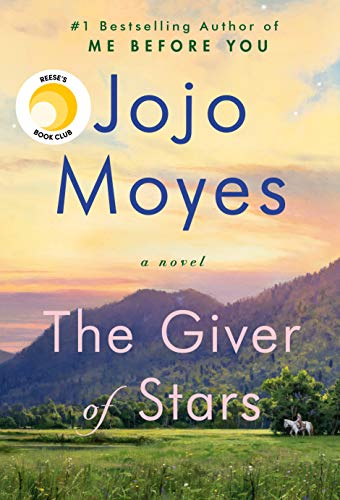
The Giver of Stars
"The Works Progress Administration's Packhorse Librarians of Kentucky program ran from 1935 to 1943. At its height it brought books to more than a hundred thousand rural inhabitants." Author Jojo Moyes writes this novel based on a true story of a small group of women who served in a small town and its surrounding rural area. They were "The Giver of Stars." A sampler in their small library said "To Seek Knowledge Is To Expand Your Own Universe." The books they provided taught children and adults how to read and enjoy "the diversion and hope that a good story could bring." They read about how to improve their daily lives and received a view of other worlds and other times.
Margery, Alice, Beth, Isabelle, Kathleen, and Sophia were the librarians in their small Kentucky town. The people who lived in the surrounding rural area looked forward to each women arriving on horseback with bags of books from the library. The librarians lives were also enriched as they learned about each family on their routes.
Sunday, May 17, 2020
Little Fires Everywhere
"The Shakers had indeed left the land that would become Shaker Heights" an affluent suburb of Cleveland, Ohio that "had been founded, if not on Shaker principles, with the same idea of creating a utopia." Elena Richardson grew up with this sense of order and regulation being the "key to harmony." She planned her life of marriage and motherhood "with a propensity to overachieve and a deep intolerance for flaws."
Mia Warren grew up in a middle-class home and left for New York to attend art school. She believed that "anything had the potential to transform, and this to her, seemed the true meaning art." Living in a variety of cities, she created her art and moved on. She and her daughter Pearl came to Shaker Heights and rented an apartment from Elena.
Mia's daughter Pearl made friends with the four Richardson teenagers and began to admire their lifestyle, seeing all the material things she had missed out on. Elena's youngest daughter Izzy felt out of place in her own family and began to admire Mia, her choice of lifestyle, her personality, and her art. "Something inside Izzy reached out to something in her and caught fire."
Other families, other mothers in Shaker Heights, tried to make the right decisions, but often made their own mistakes. "What made someone a mother? Was it biology alone or was it love?"
Mia said to Izzy that "sometimes you have to scorch everything to the ground and start over." "Sometimes you need to start over from scratch." She was referring to why she and Pearl had to move away. Izzy took her words to heart.
The novel and the TV series differ in some respects, but both tell a compelling story. I recommend both.
Thursday, May 7, 2020
CHINA RICH GIRLFRIEND
Being China Rich is just an entryway requirement to the highest status. Wealth and prestige must go back for generations. All the acquired possessions have to show elite status: the right house or penthouse apartment, luxury cars, private planes to whisk you around the world at a moments notice, couture clothes, priceless jewels, art collections, and anything else that impresses the connoisseur.
Nicholas Young comes from such a family while his finance Rachael Wu, a Chinese-American, has been raised by her mother of meager means. They go back to China to find her father she has never met.
Who is the China Rich Girlfriend?
Saturday, April 18, 2020
The Yellow House

"The Yellow House" 4112 Wilson Avenue, New Orleans East, Louisiana from 1961 until Hurricane Katrina damaged it beyond repair was home to Ivory Mae who raised twelve children there, the youngest being author Sarah M. Broom. This memoir tells the story of Broom's ancestors, parents, siblings, other family members, neighbors, and friends. This also is a story of place: the development and decline of the community just east of New Orleans and New Orleans itself including the French Quarter, both the romanticized image and the real story of the residents and workers.
Sarah Broom relates her life story as a young girl growing up who kept a journal throughout her life, went away to college, and had various jobs including as a writer for Oprah Magazine, then as a speech writer for Mayor Ray Nagin until she lost faith in his leadership rebuilding New Orleans after Hurricane Katrina.
"We are all born into histories, worlds existing before us. No place is without history." As a teenager she states, "I wrote in a notebook (my writing everything down having become, by then, habit.)." After living in other places, she rented an apartment in the French Quarter. "Thus it could be said that my reaching to understand the French Quarter was a yearning for centrality, a leading role, so to speak, in the story of New Orleans, which is to say the story of America."
Eleven years after Katrina, "Mom signed away the yellow house and its land, which she had owned for more than half a century." "The story of our house was the only thing left."
Friday, March 27, 2020
The Book of Gutsy Women
All around the world for many centuries, women have had the courage and resilience "that made the world a better place." Hillary and Chelsea Clinton present stories featuring both famous women and some not so well known; however, all deserve to have their stories told. Eleven categories include a multitude of women: Early Inspirations like Helen Keller and Anne Frank; Education Pioneers like Maria Montessori and Joan Ganz Cooney; Earth Defenders like Rachel Carson and Jane Goodall; Explorers and Inventors like Sally Ride and Marie Curie; Healers like Florence Nightingale and Clara Barton; Athletes like Venus and Serena Williams; Advocates like Eleanor Roosevelt and Gabby Giffords; Storytellers like Maya Angelou and and Ali Stroker; Elected Leaders like Bella Abzug and Barbara Mikulski; Groundbreakers like Katharine Graham and Ellen DeGeneres; Women's Rights Champions like the Suffragists and Fraidy Reiss.
Friday, February 28, 2020
The Tattooist of Auschwitz
In April 1942, Lale Sokolov, formerly know as Ludwig Eisenberg, "was just one among countless young men stuffed into wagons designed to transport livestock." They were taken to the Auschwitz-Birkenau concentration camps. For two and a half years, he endures this horrible prison and survives by being a Tatowierer. During that time, he meets Gita, and they fall in love. He tells his fellow prisoners, "I don't know what fate lies in store for any of us." "He thinks back to the vow he made at the beginning. To survive and to see those responsible pay."
Lale tells Gita, "How any merciful god could let this happen, I don't know." "I believe in you and me, and getting out of here, and making a life together..." Gita tells Lale that he "will honor them (those who suffered and died) by staying alive, surviving this place and telling the world what happened here."
And that is what happened. The Nazis were defeated. Lale and Gita married in 1945 and many years later had a son Gary. He asked his mother how she handled later challenges in life. "With a big smile on her face she said that when you spend years not knowing if in five minutes' time you will be dead, there is not much that you can't deal with."
In his later years, Lale finally told his story to author Heather Morris.
Tuesday, January 7, 2020
Educated: A Memoir
Tara Westover grew up in a rural Idaho family that didn't send its children to school or take them to a doctor. Her father dominated the family with his extreme beliefs and exaggerated interpretation of the Bible. Her mother went along with these beliefs while becoming a herbalist and a midwife. Some of Tara's siblings continued to live a similar life. Some broke away and moved on, but Tara began a long and difficult journey to another life.
She wrote in her journal, "It's strange how you give the people you love so much power over you." Nevertheless, Tara began studying and learning how to think for herself. She read about negative liberty - the freedom from external obstacles and about positive liberty - the freedom from internal constraints, "to be liberated from irrational fears and beliefs, from addictions, superstitions." She attended many universities and earned advanced degrees. "What is s person to do, I asked, when their obligations to their family conflict with other obligations - to friends, to society, to themselves?" She became "a changed person, a new self." "You could call this selfhood many things." "I call it an education."
Friday, December 27, 2019
The Handmaid's Tale
In the dystopian society of Gilead, a handmaid wrote down her tale. The country has been damaged by air, water, and land pollution which caused many of the citizens to to be infertile. Young fertile women were conscripted to conceive and bear children for the elite upperclass. The handmaid attire was red, the color of blood, and white wings were on their head piece which limited their vision.
Commander Frederick Waterford and his wife Serena Joy used Handmaid Offred to try to produce a baby. Before she resided with the Waterfords, she was a young mother named June who was caring for her daughter. That life was abruptly taken from her. The handmaids "are containers, it's only the insides of our bodies that are important." We are "two-legged wombs, that's all: sacred vessels." And so the tale continues.
Scriptural passages are used to promote the cause, to give credence to the oppressive and unjust treatment of the handmaids. Author Margaret Atwood has said that nothing went into this novel "that had not happened in real life somewhere at sometime." This story can shed light on past and present issues, and give warning of what could possibly happen in our future.
Saturday, November 30, 2019
Big Little Lies
"Big Little Lies" include the ones people tell themselves and the ones they tell others. Omissions and commissions, secrets kept, and falsehoods spread, all stray from the truth. Celeste and Perry, Madeline and Ed, and single mom Jane seem to be living happy normal lives as parents of students at Perriwee Public School, "where we live and learn by the sea."
As the women meet each other, they are the image of successful moms, but as they get to know each other, a more honest picture is revealed. Celeste wants to leave her husband but pretends all is well. Madeline is trying to adjust to sharing her daughter with her first husband Nathan and his young wife. Jane is raising her son alone keeping the identity of his father to herself. Both adults and children are keeping secrets and living with the consequences.
Some lies were to protect someone, some were misunderstandings, yet some were malicious gossip. Celeste finally realizes "all the perfect little lies" she'd told herself needed to be shared, "to say the bare ugly truth, to hold nothing back."
Their lives are not as sweet as first portrayed. Eventually, the lies are shattered, and the healing begins.
Monday, November 18, 2019
The Forgotten Garden
Thursday, October 24, 2019
A GENTLEMAN IN MOSCOW
In 1922 at age 33, Count Alexander Rostov is sentenced to house arrest in the Metropol Hotel in Moscow. He resides there for 30 years believing "if a man does not master his circumstances, then he is bound to be mastered by them." As an educated aristocrat, he uses his wit and charm, befriends employees and residents, and learns to survive within the hotel. Throughout his life, Rostov learns that "every period has its virtues, even a time of turmoil."
He experiences love from being a father to his adopted daughter and from a romance with Anna, a willowy movie actress. His longtime friend Mishka was loyal from college days to the end. Young Sofia said the Count was "a man inclined to see the best in all of us."
Author Amor Towles shows us Russian history and how people suffer, adapt, and survive. Hope and determination leads many of them to find contentment and happiness. "A Gentleman in Moscow" is captivating.
Monday, September 2, 2019
The Chaperone
In 1922 New York City, Cora was the chaperone of Louise, a teenager from Kansas determined to become a star. Two different generations with two different outlooks on life concerning outward appearances, behavior, and ambition. "Maybe the old rules were changing." Maybe Cora "was falling behind the times, as provincial and outmoded in her thinking as in her dress." But on the other hand, the young "can drag you, as you protest and scold and try to pull away, right up to the window of the future, and even push you through." Later on Cora realized: "She'd lived too much of her life so stupidly, following nonsensical rules, as if she...as if anyone, had all the time in the world." After that life-changing summer, Cora went back to Kansas and Louise was off to Hollywood.
Friday, July 12, 2019
Robicheaux
James Lee Burke gives us Dave Robicheaux, a seasoned detective in southern Louisiana, who appreciates the beauty of the swamps and bayous, shows love and loyalty to his friends, family, and co-workers while dealing with his troubled past. As he investigates crimes, he sees all sorts of characters, the good and the bad, the troubled and the criminal. His best friend of many years Clete Purcel assists in tracking down the evil criminals.
Wednesday, July 3, 2019
The Moment of Lift
Her biggest discovery is how empowering women changes the world. She states, "When you lift up women, you lift up humanity." "Sometimes all that's needed to lift women up is to stop pulling them down." Equal rights are "still often denied by cultural bias against women."
She continues, "Being a feminist means believing that every woman should be able to use her voice and pursue her potential, and that women and men should all work together to take down the barriers and end the biases that still hold women back."
By receiving vaccines, contraception, maternal and newborn care, and education, women, their children and their society can be lifted out of poverty. "When the women were able to time and space their pregnancies, they were more likely to advance their education, earn an income, raise healthy children, and have the time and money to give each child the food, care, and education needed to thrive. When children reach their potential, they don't end up poor. This is how families and countries get out of poverty."
All the countries around the world including the U.S. need to assure women have equal rights. Melinda Gates states, "It's the mark of a backward society - or a society moving backward - when decisions are made for women by men.That's what's happening right now in the U.S." "If a girl can lift up her view of herself, she can start to change the culture that keeps her down."
Look around your own country, state, and community, then realize the various ways the culture, some religions, and government need to change. We all can have equal rights and be lifted up to a better life.
Thursday, June 6, 2019
Where the Crawdads Sing
In 1952, Kya is six years old, the youngest of five children, who live in the marshland of North Carolina "where critters are wild, still behaving like critters," where "biology sees right and wrong as the same color in a different light," where "man reverts to those instincts that aim straight at survival," "way out yonder where the crawdads sing." In 1969, the body of Chase Andrews is found dead. What happens before and after solves the mystery.
Author Delia Owens tells a story with style and substance of how we humans have the ability to survive, grow and face the challenges of life or choose a path that leads to destruction.
Tuesday, May 28, 2019
Mama’s Last Hug
Mama, a chimpanzee matriarch, was near death, but when a biologist she had known for forty years came to visit, she showed joy through her smile, her sounds, and gentle strokes of his hair and pats on his head. She then gave him a last hug. This demonstration showed emotions and feelings that all of us primates share. Author Frans de Waal is a primatologist who has studied animal emotions and associated facial expressions, sounds, gestures, and behaviors. Some of the many emotions all primates share include sadness, happiness, love, hate, anger, fear, disgust, shame, guilt, depression, pride, sympathy, empathy, affection, and sexual desire.
De Waal states: "I believe that all the emotions we are familiar with can be found one way or another in all mammals." "Primates are made to be social, made to care about each other, made to get along, and the same applies to us." "Emotions can be good, bad, and ugly, which is as true for animals as it is for us."
All primates including humans have many similar physical characteristics like having hands, forward facing eyes, and large brains. We also have similar emotions, facial expressions, and gestures. Even our behaviors are similar. Frans de Waal writes about animal emotions and what they tell us about ourselves.
Thursday, March 28, 2019
"The Last Mrs. Parrish"
Part I reveals Amber's story, Part II Daphne's, and part III the resolution. Thinking you know what you want and doing whatever it takes to get it may bring many unexpected results. After you get what you think you wanted, it may turn out to be something completely different. "Oh, what a tangled web we weave, when first we practice to deceive!" (Sir Walter Scott, 1808)
The black cover of the book could be a warning this novel has a dark side. The cover also states: "Some women get everything. Some women get everything they deserve." Liv Constantine is the pen name of sisters Lynne Constantine and Valerie Constantine.
Tuesday, March 19, 2019
"Necessary Lies"
Everyone needs help sometime in their lives, and many of us can provide help either personally or through social services. But who decides the best way to help and thereby benefit society as a whole? Even with the best efforts, some people can barely survive. Even with the best intentions, the type of help offered may not be what others really need.
The causes of poverty are numerous including being born into a family of meager means, low intelligence, insufficient education, and lack of a family support system. The results of poverty are also numerous including insufficient housing, nutrition, and medical care.
Diane Chamberlain's "Necessary Lies" is based on real conditions in rural 1960 North Carolina and reveals how poor families lived and how social workers helped and hindered their situation. Tenant families on a tobacco farm, dependent on the owner, had to struggle to survive. Two sisters and their family living and working on the farm needed help. A social worker assigned to them realized that the family and the agency needed to change.
For those of us not born into poverty, our understanding of the situation is meager and even prejudicial. We might feel that if they only tried harder, worked harder, and lived a moral life, they could escape the situation. Some even feel that the government helps too much and even slows their progress toward independence. "Necessary Lies" shows how revealing the truth serves us best.
Monday, February 4, 2019
“As I Lay Dying”
In a southern farmhouse, Addie Bundren lay dying. She and her family plus many other characters, multiple narrators, describe the events throughout the story. Each person can only see through their own eyes with limited understanding due to their past experiences, opinions, and emotions. While presenting various points of view, some people try to understand others, but everyone influences present and future events surrounding Addie’s death and the following journey.
Faulkner illustrates how the survival instinct is part of human nature. Some people also have the instinct to protect and develop their children. A few may extend their empathy to their social contacts and even to strangers. For self protection, people keep secrets and only reveal what serves their own purposes.
Addie’s doctor realizes, “I can remember when I was young, I believed death to be a phenomenon of the body; now I know it to be merely a function of the mind - and that of the minds of the ones who suffer the bereavement.” After Addie dies, her final wish is fulfilled as her family makes the journey to return her body back to her hometown.